


Feb 10, 2026
Foreign Entity of Concern (FEOC) Regulations for Battery Energy Storage Systems (BESS)
Definitions
Under §48E, BESS is treated as an ‘Energy Storage Technology’ or EST
An EST is defined (by reference to §48 (c) (6) as property that:
Receives, stores, and delivers energy for conversion to electricity
Has a nameplate capacity ≥ 5 kWh
Is not primarily used for transportation
Includes thermal energy storage properties
BESS qualifies for §48E Clean Electricity Investment Tax Credits if:
It is placed in service after December 31, 2024
Construction begins after statutory termination dates
It does not include material assistance from a Prohibited Foreign Entity (PFE) if construction begins after December 31, 2025
Determination is based on supplier's tax year at time of cost payments

Material Assistance Cost Ratio
For BESS eligibility depends on definitions under 7701 (a) (52):

Total direct costs include direct material, direct labor cost of Manufactured Products (MPs) and components incorporated into the EST
PFE direct costs are the portion attributable to MPS or Manufactured Product Components (MPCs) that are mined, manufactured and produced by a PFE.
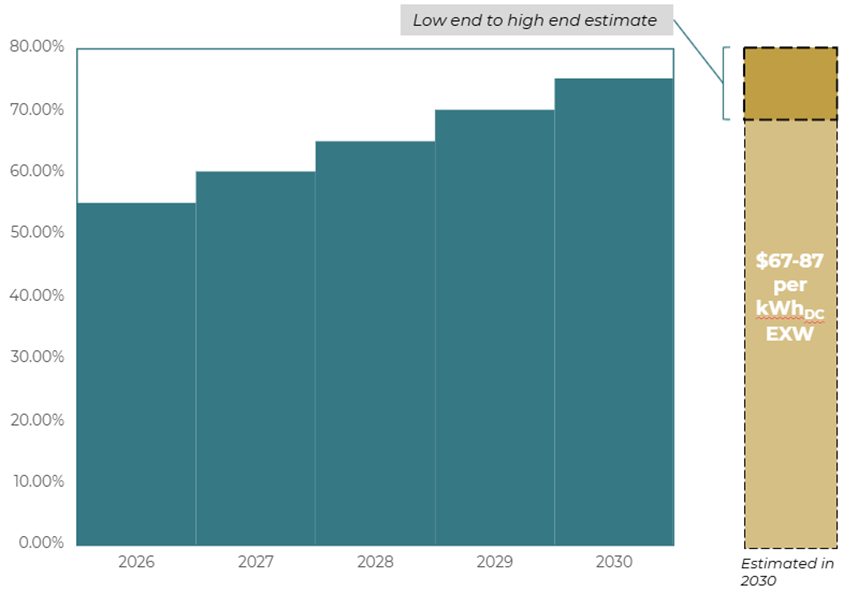
If MACR is below the applicable threshold, the EST includes material assistance from a PFE and is ineligible
The threshold percentage are as follows:
55% in 2026
60% in 2027
65% in 2028
70% in 2029
75& in 2030 and beyond
Technical Cost Components
For MACR, only MPs and MPCs are included, some examples are:
Battery modules
Battery packs
Battery cells
Inverters
Power conversion systems
Control systems
Thermal management systems
Steel and iron-based structural components are excluded from MACR unless identified as MPs or MPCs
Main power transformers can be ignored
However, it is important to note that asset owners must focus only on a discrete number of MPs and MPCs for MACR calculations

Tracking Methodologies
Notice 2026-15 establishes three tracking methodologies:
Individual component tracking, where each MP or MPCs is tracked to specific BESS units
De-minimis assignment (10% rule), where each MP or MPCs representing < 10% of total direct costs may be assigned across facilities
Averaging for small BESS (<1 MWAC)
Must be of same type
< 1 MWAC
Placed in service same taxable year
Taxpayers may average direct costs and PFE production percentage. This is especially relevant for Distributed Generation (DG)BESS portfolios

Applicable Safe Harbors
Two interim safe harbors apply as of the date of the notice:
Identified safe harbor - Use 2023-2025 Safe Harbor Tables (Notice 2025-08) to identify and qualify and quantify MPs/MPCs
Cost percentage safe harbor - Use assigned cost percentages instead of actual cost tracking (only if using identification safe harbor)
It is important to note that safe harbor is:
Not allowed for incremental production rule projects
Excluding used property under 80/20 rule from MACR calculations
Per Notice 2025-08, a grid-scale BESS is one with a name plate capacity greater than 1 MWh, where as distributed BESS shall have a nameplate capacity less than or equal to 1 MWh

Qualified Interconnection Property
If BESS includes qualified interconnection property:
Separate MACR must be calculated
If interconnection property fails MACR,BESS ITC can still be claimed but interconnection costs are excluded from qualified investment
Qualified interconnection property could include network upgrade costs paid to the interconnecting utility – the IRS has recommended separate MACR calculations for these network upgrades
It is imperative to work in concert with the utilities to determine cost and sourcing of equipment to accurately quantify and qualify an interconnection specific MACR

The Risk of not Being Diligent
If MACR is overstated, then:
20% accuracy penalty applies
1% understatement threshold instead of10%
6-year statute of limitations of MACR-related deficiencies
Supplier misstatements subject to§6695B penalties
That said, there is both economic and reputational risk of not being diligent about strategic sourcing
The onus of traceability is solely on the developer's shoulders and goes beyond traditional checklists and CAPEX focused decision making

Technical Implications
Supply chain strategy
Track origin of battery cells and modules carefully
Avoid PFE-produced battery cells unless MACR remains above threshold
Portfolio structuring
Consider < 1 MW averaging rule for distributed projects
Use the safe harbor cost tables where advantageous
Contracting
Ensure supplier certifications, but be diligent about reviewing these in detail due to potential penalties at play
Avoid licensing arrangements that could trigger ‘effective control’ by PFEs
Financial modeling
Build MACR analysis into tax equity underwriting
Model threshold compliance by construction year
Future Guidance
The IRS is still working on FEOC, so the current notice is one of many expected in the coming months
FEOC also bans tax credits from being claimed on any project or product over a Specified Foreign Entity(SFE) has been effective control by contract
Congress wrote into the statute 13 contract clauses that are leading signs of effective control to ensure non-circumvention
Granting the rights to use Intellectual Property (IP) belonging to an SFE, or modifying an existing contract, on or after July 4, 2025, is automatically considered to give the SFE effective control and as such automatic disqualification from a tax-credit perspective
FEOC explicitly bars any company that is a PFE from claiming federal tax credits
The IRS is seeking comments on the current notice up until March 30, 2026
Reach out to us at @hello.camelotenergygroup.com for any questions!